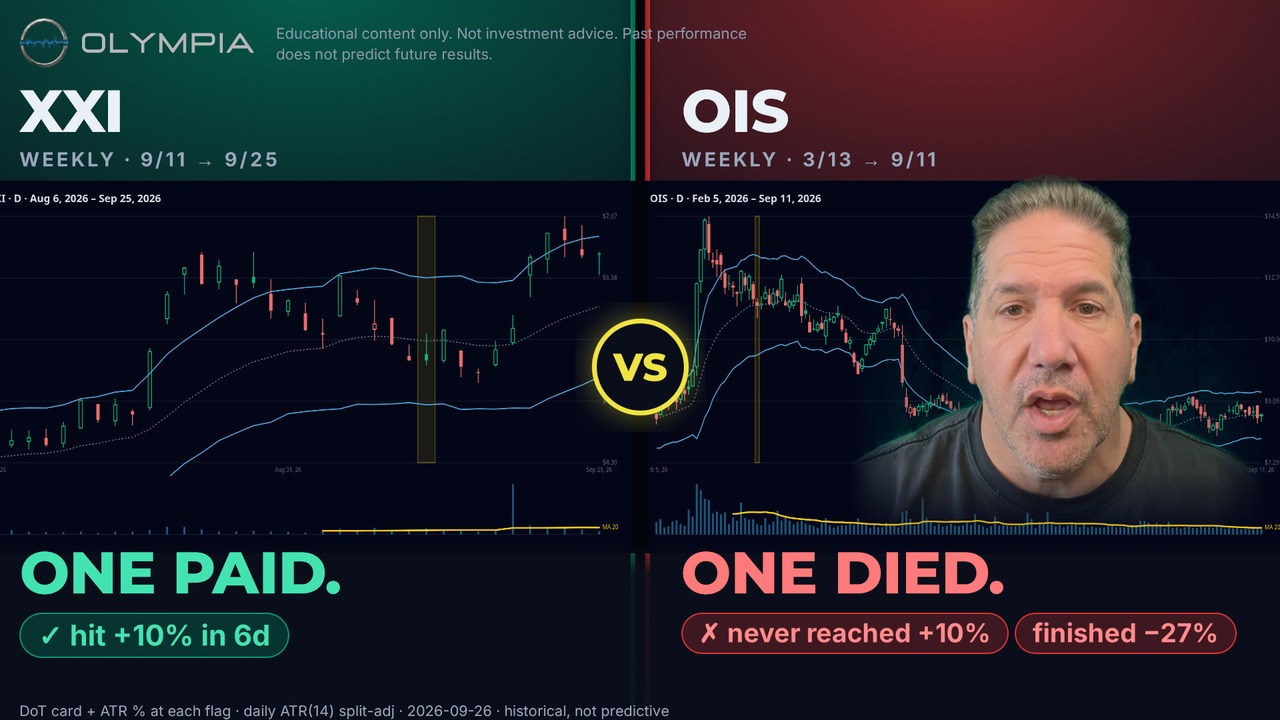
How many shares should I buy? Position size from your risk
Lesson · Risk & sizing · October 1, 2026
Olympia publishes educational content for learning purposes only. Past performance is not indicative of future results. Nothing here is investment advice.
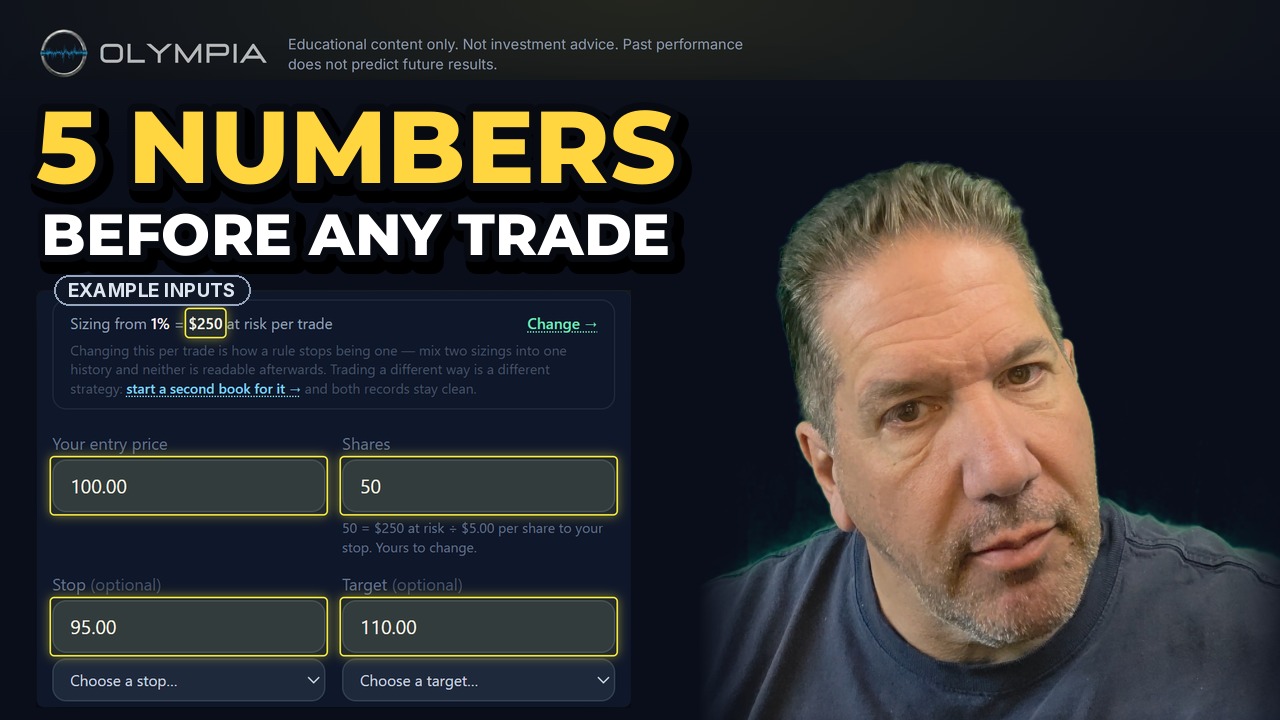
Four numbers exist before you ever click the buy, and the price you pay is the fifth. Your R — the most a trade is allowed to hurt — comes from your account, not from the stock. Then the stop, then 1R, 2R and 3R measured off it, and the share count falls out of a single division. The entry is the last number, not the first.
The lesson in writing
Every one of these begins life with the last moment. The start is the last thing you want to plan.
I'm Mike, and I built Olympia. Four numbers exist before you ever click the buy — and the price you pay is the fifth.
What it is
Before a dollar goes on a trade, one number is already decided: the most it's allowed to hurt before you tap out. That's your R — one unit of risk, the ruler you measure the whole fight with.
It doesn't come from the stock. It comes from your account: a percent you pick once, while you're calm, the same in every fight.
The stop is the exit you decide before you're in. Not a feeling — a price. The distance from your entry down to the lowest price you're willing to risk, that's one R.
Turned around, the same ruler measures the win. If 1R is what you're risking, 2R is twice that and 3R is three times it. Measured up from your entry: what satisfies you? What do you want to win by?
You decide all of it calm, while you're thinking straight. Decide it during the fight and you're deciding while you get knifed — and pain always argues for one more chance.
How it's worked out
Twenty-five thousand dollars in an account. One percent: two hundred and fifty dollars. That's what this fight is going to cost you if you lose and you throw in the towel.
Say you're in at a hundred dollars a share, and at ninety-five you're out. That's five bucks, and the five is one R.
Up 1R you're at 105. Up 2R, 110. At 3R, 115. In fifty shares that's two hundred and fifty dollars, five hundred, seven hundred and fifty. The number you're willing to lose is the same number that tells you what you think a win is.
Here's where the size comes from — and it isn't how much you like the stock, which shouldn't matter at all. Take the dollars you're willing to lose and divide them by the distance to your stop. Two hundred and fifty at risk, five dollars from your purchase price down to your stop: fifty shares.
Tighten the stop to two dollars fifty and it's the same thing — a hundred shares, the same two hundred and fifty at risk. You never pick the size. You pick the loss, and the arithmetic tells you the size.
By this point four numbers already exist: your R, your target, your stop and your share count. There's only one left. Entry.
Why the order is the whole lesson
Most beginners build the trade in exactly the wrong order, and it costs them. The entry comes first, because it's moving. Then a stop invented halfway down, while it's in motion, while it hurts. Then the size picked by how good the story sounded. Then a target invented later, to justify holding on.
Every one of those gets decided at the worst possible moment: inside the trade, while it hurts, while the money's moving.
Run it the other way and it's discipline. It's already been decided — you don't have to do the hard thinking, because it's done before you're exposed to the risk, and before things start to go sideways.
Every time, the picks get the blame. But it's the order that did the damage.
Why the stop and the targets come first
Because losses don't come back even. Lose ten percent and you need eleven to get back. Lose half and you need to double. Stops keep you in the fight.
One R caps the damage before you're in. One percent — two hundred and fifty dollars on twenty-five thousand — is not a big deal. And the rest of that money doesn't just sit there: you're taking your eggs and putting them in five strongly researched baskets. One or two fall, two fifty, five hundred. No big deal.
If you think one percent is too small for your style, two percent works. Five is considered aggressive: ten losers in a row at five percent takes about forty percent of your account out of the picture, and now you're looking for the door. And with no stop at all, a single position can take a multiple of your R out of the account in one trade.
Targets use the same ruler. At three R, one win pays for three losses — so win one in three and you're ahead. That's arithmetic, not a promise about any one trade.
Where Olympia calculates it
Olympia shows it where you log the trade: two hundred and fifty dollars at risk, one percent, for that trade. Your risk sits at the top of that window, above every other number.
On the stop field there's a menu — one off the stock's own daily range, a trailing one, or a measured safety exit. You pick one and it writes the number in. The targets come off your own stop, and each one is a price.
The shares line does the division and shows you its working: fifty, because two hundred and fifty at risk divided by five dollars a share.
And it doesn't hand you a single price for the entry. It draws a band — one of the stock's own normal moves either side of the middle — because a plan that needs one exact penny isn't a plan at all. That sits on the plan card as the entry zone, with today's price marked inside it, or outside it.
Entry, stop, target: all three decided before you click anything. The click is the end of the plan, not the beginning.
Example numbers, not a member's: a $25,000 account at 1% risk, in at $100 with a $95 stop, in Olympia's I'm In window. Every figure here is arithmetic worked from those inputs — the R, the 1R/2R/3R prices, the share counts, the recovery math — not a forecast and not a result. Whether a trade pays is never worked out here. What is worked out is what it is allowed to cost.