Stop and target in one plan — risk-reward
Short · Risk & sizing · October 7, 2026
Olympia publishes educational content for learning purposes only. Past performance is not indicative of future results. Nothing here is investment advice.
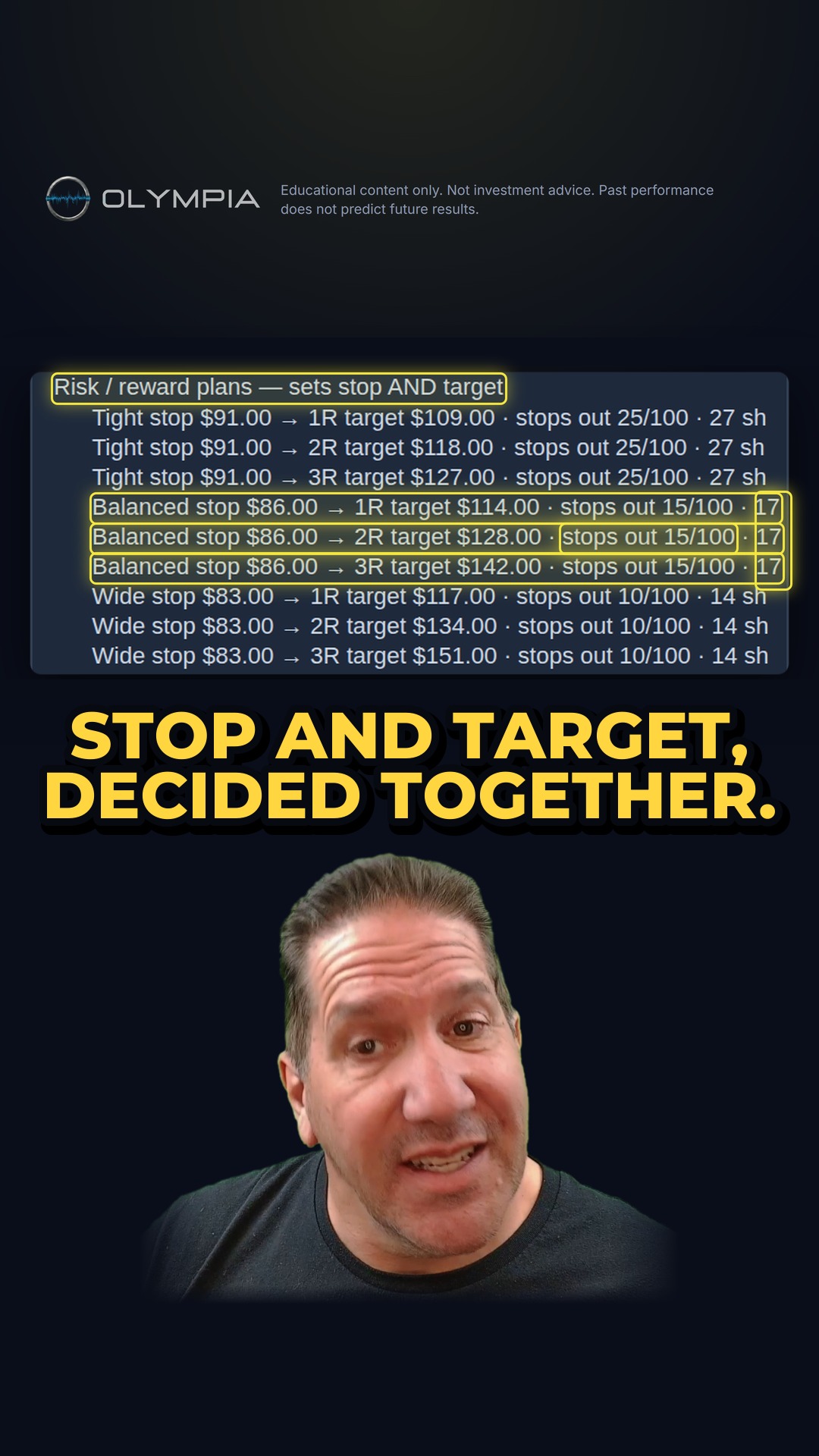
A stop without a target is half a plan. Take the stop off the measured ladder and set targets in multiples of the distance to it: in at $100 with the balanced stop at $86, $14 is 1R, so 2R is $128 and 3R is $142 — with the share count for $250 at risk.
Part of the full lesson: Stop loss or trailing stop? Which one, and where it goes
The lesson in writing
So you picked a stop, but you forgot your target. Well, that's half the plan.
What it is
A risk-reward plan picks both at once: a stop from Olympia's measured ladder — tight, balanced or wide — and targets in multiples of the distance to it. That's your R.
How it's worked out
So you're in at $100 and your balanced stop is at $86. $14 is 1R. 2R, $128, is your profit target. 3R, $142, is your profit target.
And both sides are measured. The balanced stop stopped out 15 of every 100 that went on to pay. On the target side: of every 100 monthly signals with that balanced stop, 2R came first about 39 times, 3R about 28.
So you've got one signal, and now you've got the stop and the target all decided together.
Where Olympia calculates it
Olympia lists every pairing on the stop menu with the shares for $250 at risk — 17 on this one.
Where the ladder's rungs come from is in Stop loss or trailing stop? Which one, and where it goes.
The stopped-out and target-first counts are Olympia's own measured record for monthly signals with the balanced rung, as it stood on 2026-09-29. The $100 entry, the $250 at risk and the 17 shares are example numbers, not a member's; the R multiples are arithmetic on them. Measured and backward-looking, not a forecast.